
Why Threat Intelligence Is a Game-Changer for MSPs and How to Use It Effectively
Discover how threat intelligence helps MSPs protect clients from evolving cyber threats. Learn about the types, benefits, and how to effectively implement them into your services.
Cyberattacks are getting more targeted and costly every year. In 2024, the global average cost of a data breach skyrocketed to $4.88 million, up 10% from $4.45 million the year before, the largest annual jump since the pandemic. For MSPs, that number is more than just a headline metric; it’s a reality reflecting growing client expectations for proactive and comprehensive security.
As organizations increasingly rely on digital infrastructures, they are not only looking for antivirus or firewall solutions. They expect their MSPs to act as strategic partners who can anticipate threats rather than merely react to them. Clients want insight into not just what went wrong, but why, and how it might happen again.
That is where threat intelligence for MSPs becomes a game-changer.
In this blog, we will break down what threat intelligence is, why it matters for MSPs, the different types it involves, and the threat intelligence cycle. We’ll cover its core benefits and walk through practical steps MSPs can take to implement it effectively. Whether you’re servicing small businesses or scaling up for mid-market clients, embedding threat intelligence into your offerings can elevate your value and help manage risk with greater confidence.
Stick around to see how threat intelligence can help you stay a step ahead, reduce noise, and build stronger client trust.
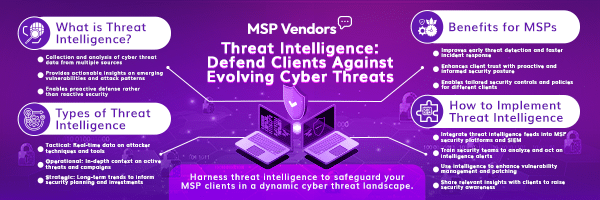
What Is Threat Intelligence?
Threat intelligence is actionable insight about cyber threats: who’s behind them, how they operate, and what vulnerabilities they target. For MSPs, it goes beyond raw data or alerts. It’s about understanding threats in context and using that knowledge to prevent attacks before they happen.
This intelligence is gathered from various sources, including public feeds, security vendors, and internal logs. But its real value comes from connecting the dots, tying an IP address or malware signature to a known attacker or tactic, for instance.
Instead of reacting to incidents, MSPs armed with threat intelligence can anticipate risks, prioritize what matters, and advise clients with confidence. It turns noise into clarity, helping you protect clients in a smarter, more focused way.
Why Is Threat Intelligence Important?
Most MSPs already have monitoring tools in place, but they often lack the bigger picture: why something is happening, who is behind it, and what could happen next. That’s the gap threat intelligence fills.
By understanding the context around threats, MSPs can move from reactive fixes to proactive defense. It helps reduce false positives, speed up response times, and align security strategies with real-world risks.
For example, if a phishing domain is flagged, threat intelligence can tell you if it’s linked to a known attacker group, what their typical payloads are, and which industries they target. That level of insight allows MSPs to prioritize threats that pose a real danger to clients.
In short, threat intelligence helps MSPs act faster, respond smarter, and deliver more strategic value, especially as threats grow more complex and targeted.
Types of Threat Intelligence
Not all threat intelligence is the same. To be useful, it must match the needs of your clients and your team. Here are the four main types MSPs should understand:
Strategic
This is high-level intelligence that focuses on long-term trends, threat actor motivations, and industry-wide risks. It helps MSPs and clients make informed security decisions, align budgets, and prepare for emerging threats.
Operational
Operational intelligence looks at specific threat campaigns, including when, where, and how they’re likely to occur. It’s useful for MSPs managing client risk posture or preparing defenses against targeted attacks.
Tactical
Tactical intelligence provides details on how attacks are carried out, TTPs (tactics, techniques, and procedures) used by threat actors. It helps your team configure defenses and detection tools more effectively.
Technical
This type is the most granular. It includes indicators of compromise (IOCs) like malicious IPs, URLs, file hashes, and domain names. Technical intelligence is often short-lived but essential for immediate detection and response.
Understanding these types allows MSPs to deliver intelligence that’s not only accurate but also actionable and relevant at every level.
What Is the Threat Intelligence Cycle?
The threat intelligence cycle is the structured process that turns raw data into useful insights. For MSPs, following this cycle helps ensure that threat data is not just collected but actually applied to client security decisions.
Direction
It starts with defining what you need to know. Are you tracking ransomware trends? Specific vulnerabilities? Direction helps set the goals for your intelligence efforts.
Collection
Once objectives are clear, the next step is gathering data from sources like threat feeds, logs, security vendors, or even dark web forums.
Processing
Raw data is often messy and unstructured. This stage involves organizing, filtering, and formatting the information so it can be analyzed effectively.
Analysis & Production
This is where patterns emerge. Analysts interpret the data, connect dots, and produce actionable reports or alerts based on what they find.
Dissemination
Insights are shared with relevant teams or clients. For MSPs, this might include a security advisory, patch recommendation, or an update to internal policies.
Feedback
The cycle ends by evaluating the usefulness of the intelligence. Did it help? What needs improvement? Feedback helps refine future collection and analysis efforts.
Following this cycle helps MSPs deliver intelligence that is timely, relevant, and continuously improving.
Benefits of Threat Intelligence
For Managed Service Providers, threat intelligence is a practical, strategic asset that improves how you protect clients and run your operations. Integrating threat intelligence into your service stack can strengthen every layer of cybersecurity, from daily monitoring to long-term planning.
Proactive Defense
Traditional defenses often rely on reacting to threats after damage has started. Threat intelligence changes that by allowing MSPs to get ahead of the curve. With access to timely indicators of compromise (IOCs), threat actor profiles, and exploit trends, your team can block emerging threats before they hit a client’s network.
For instance, if intelligence reveals a rise in credential-stuffing attacks targeting healthcare clients, you can strengthen MFA policies or adjust firewall rules across affected environments before there’s a breach. It shifts your posture from reactive to preventative.
Informed Decision-Making
Security alerts can be overwhelming, especially when false positives crowd out real threats. Threat intelligence adds much-needed context to help MSPs separate noise from signals. Knowing which attacker group is active, how they operate, and what systems they target helps prioritize response efforts based on actual risk, not just severity scores.
This also guides resource allocation. Whether you need to patch critical vulnerabilities, reassign staff to investigate active threats, or alert a client to potential data exfiltration, intelligence-driven decisions are faster and more focused.
Tailored Security Measures
Every client has a different risk profile. A retail business faces different threats than a legal firm or a manufacturing plant. Threat intelligence allows MSPs to tailor defenses based on a client’s industry, size, compliance requirements, and technology stack.
For example, if you’re managing clients in regulated sectors like finance or healthcare, threat intelligence can surface risks related to specific data-handling practices, such as targeted phishing lures or ransomware strains affecting similar organizations. That insight lets you proactively adjust endpoint policies, backup configurations, and user training to fit real-world threats your client actually faces.
Incident Response and Mitigation
When something goes wrong, threat intelligence helps you respond with speed and precision. During a breach, it offers insight into the attacker’s goals and next steps. That information can reduce containment time, prevent spread, and avoid unnecessary downtime.
Let’s say a malicious domain is flagged on a client network. With threat intelligence, you can quickly determine if it’s part of a known campaign, identify the malware family, and understand how it propagates, allowing you to isolate systems and deploy countermeasures with confidence.
It also helps improve post-incident reporting. Instead of vague summaries, you can give clients concrete answers about who attacked them, why it happened, and how they’re now protected. That level of transparency builds trust and demonstrates the value of working with an MSP that doesn’t just respond but understands the bigger picture.
How Can MSPs Implement Cyber Threat Intelligence for Clients?
Implementing threat intelligence doesn’t mean building a full-blown SOC or hiring a team of analysts overnight. For MSPs, it’s about integrating intelligence into your existing workflows and using it to strengthen client protection, response, and service delivery.
Here’s how you can start putting threat intelligence into action:
Deploy Patches Faster to Avoid the Newest Security Threats
Threat intelligence provides real-time updates on active vulnerabilities, especially those already being exploited in the wild. By incorporating these feeds into your patch management process, you can move faster when it counts.
Rather than patching on a routine schedule, your team can prioritize based on actual threat activity. This helps reduce risk exposure, especially for zero-day vulnerabilities or critical CVEs linked to known exploits.
Improve Network Security Operations
Threat intelligence gives context to the traffic and behaviors you’re monitoring. If your team sees unusual outbound connections or login attempts, intelligence feeds can confirm whether they’re tied to malicious IPs, domains, or attacker infrastructure.
This leads to smarter alerting, fewer false positives, and better tuning of detection rules. Your SOC or NOC can shift from constantly chasing alerts to focusing on events that matter.
Enhance Attack/Threat Response
When an incident happens, having intelligence on hand accelerates response. You can quickly identify whether an IOC is part of a broader campaign, what the attacker’s goals might be, and which systems are likely targeted next.
This shortens dwell time, improves containment, and allows your team to act decisively. It also enables you to communicate with clients more effectively during incidents, offering insights, not just updates.
Refine Triage and Remediation Procedures
Not every alert is urgent, and not every client has the same tolerance for downtime. Threat intelligence helps MSPs triage issues based on severity, relevance, and real-world risk.
You can prioritize remediation efforts by focusing first on the most active and dangerous threats in the landscape. It also supports post-incident cleanup, offering guidance on persistence mechanisms, lateral movement indicators, and recovery validation steps.
When used consistently, threat intelligence becomes more than just a background feed. It turns your team into a proactive security partner, capable of responding faster, with more confidence and precision.
Take the Next Step: Integrate Threat Intelligence into Your MSP Strategy
Staying ahead of cyber threats requires more than just good tools; it takes the right insight at the right time. Threat intelligence for MSPs isn’t optional anymore. It’s the key to faster response, smarter decisions, and stronger client trust.
If you’re ready to elevate your security offering, start by aligning your services with intelligence that drives action. Whether you’re building in-house capabilities or exploring vendor partnerships, the right threat data can change how you protect and scale.
Explore trusted solutions, strengthen your stack, and turn intelligence into impact.