
Why Endpoint Security Is Now Non-Negotiable for MSPs (And How to Get It Right)
With remote work and endpoint sprawl on the rise, MSPs are on the front lines of securing client devices. Discover modern endpoint security solutions, from EDR to MDM, and how MSPs can address evolving threats and resource gaps.
As an MSP, you’re no stranger to the daily tug-of-war between keeping clients secure and staying ahead of relentless cyber threats. But in 2025, that tug is turning into a full-on battle, especially at the endpoint level.
Remote work is no longer a trend, but a fixture. Employees access sensitive systems from laptops, phones, and even IoT devices, all scattered across different networks and geographies. And attackers know this. According to the IBM X-Force Threat Intelligence Index 2024, endpoints are involved in 70% of all successful breaches, yet only 43% of organizations have an endpoint protection strategy in place that covers every device type.
For MSPs, this creates both a pressure point and an opportunity. Clients increasingly expect you to secure their expanding endpoint ecosystem, without slowing them down. But doing that at scale takes more than just installing antivirus and calling it a day.
In this blog, we’ll break down what modern endpoint security looks like, why it’s now a cornerstone of any resilient IT environment, and how MSPs can deliver protection that’s both comprehensive and manageable. From EDR to SASE, we’ll walk through the tools, tactics, and real-world challenges that shape endpoint security in the MSP space today.
Let’s get into it.
What is Endpoint Security?
Endpoint security refers to the practice of securing end-user devices, like laptops, desktops, mobile phones, and servers, from cyber threats. These endpoints serve as entry points to a business network, making them prime targets for attackers seeking access to sensitive data or systems.
For MSPs, endpoint security is more than just basic device protection. It’s about ensuring that every connected device is monitored, managed, and defended in real time, regardless of where it sits: on-site, remote, or in the cloud. This includes threat prevention, detection, and response across all client environments.
In short, endpoint security is the frontline of defense in today’s decentralized IT landscape, and MSPs are the ones holding the line.
The Growing Importance of Endpoint Security
The explosion of remote work, evolving threat tactics, and the sheer number of devices connecting to business networks have forced a shift in how endpoint security is prioritized. For MSPs, the risks are no longer hypothetical; they happen in real time across client environments. Here’s why endpoint protection now sits at the center of your security stack.
Remote Work
Remote and hybrid work have become permanent fixtures in many industries. But with that flexibility comes a serious trade-off: users are logging in from home networks, personal devices, and unsecured Wi-Fi. These setups often fall outside the reach of traditional firewalls or network security controls, creating wide gaps in visibility. MSPs are expected to close those gaps, without slowing down business operations.
Increase in Attacks
Cybercriminals are increasingly targeting endpoints because they’re easy to exploit and hard to monitor at scale. Threats like ransomware, credential theft, and fileless malware often begin at the endpoint. And many small and mid-sized businesses, which rely heavily on their MSPs, don’t have internal resources to detect or respond quickly. This puts added pressure on service providers to not just prevent attacks, but to spot them early and act fast.
Increase in Endpoints
The number of endpoints in most organizations has ballooned. It’s no longer just workstations and servers. Think about smartphones, tablets, IoT devices, remote desktops, and cloud-connected tools. Each of these is an access point and a potential liability. As client networks grow more fragmented, so does the risk. MSPs need solutions that can scale across device types without sacrificing control or security.
Types of Endpoint Security Solutions
Not all endpoint security tools are created equal. For MSPs, choosing the right mix isn’t just about ticking boxes, but aligning each tool with client needs, infrastructure, and risk profile. Here’s a closer look at the most widely used endpoint security solutions and how they fit into a modern MSP’s service delivery.
Antivirus
Traditional antivirus software still plays a role, especially in basic malware prevention. It scans for known threats using signature-based detection and is often the first layer of defense on endpoints. However, it’s limited to newer, more sophisticated attacks that don’t rely on known patterns. For MSPs, antivirus is the starting point, but not the full picture.
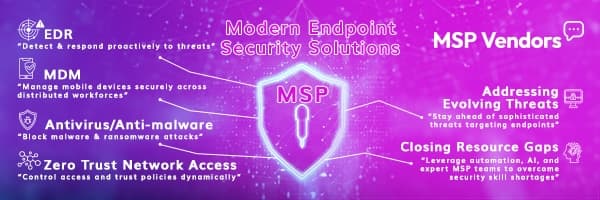
Endpoint Detection and Response (EDR)
EDR solutions go far beyond antivirus by offering real-time monitoring, behavioral analysis, and threat hunting capabilities. They allow MSPs to detect suspicious activity, isolate compromised devices, and investigate incidents, all from a central dashboard. For clients with growing security needs or compliance obligations, EDR brings depth and visibility that basic tools can’t match.
Extended Detection and Response (XDR)
XDR builds on EDR by pulling in data from multiple sources, like endpoints, cloud, email, servers, and more, into one unified platform. This cross-layered approach helps MSPs detect threats that move laterally across environments and respond more effectively. For MSPs managing multiple security tools across diverse environments, XDR reduces blind spots and brings everything together.
Mobile Device Management (MDM)
MDM tools are essential for securing smartphones and tablets, especially in BYOD-heavy environments. They let MSPs enforce policies like device encryption, remote wiping, and app restrictions. For clients with a mobile workforce, MDM is critical for keeping corporate data secure even when it lives on a personal phone.
Secure Access Service Edge (SASE)
SASE combines network and security functions, like secure web gateways, zero trust access, and firewall-as-a-service, into a cloud-delivered model. While it goes beyond endpoint security alone, it plays a key role in securing how endpoints connect to systems. For MSPs managing hybrid networks, SASE enables secure access for users regardless of location, without the complexity of traditional perimeter-based models.
The MSP Role In Establishing Endpoint Security
As clients face increasingly complex threats and environments, they rely on MSPs not just for tools but for execution. Endpoint security isn’t a “set it and forget it” job. It requires consistent oversight, proactive response, and smart automation. Here’s how MSPs can take the lead in securing every endpoint across the environments they manage.
Automate Endpoint Updates with Simple Commands
One of the easiest ways for attackers to infiltrate a system is through outdated software. Yet patching often gets overlooked, especially on devices outside of a traditional office network. That’s where MSPs come in. By automating OS and third-party application updates, MSPs can ensure endpoints are consistently patched without needing manual touchpoints.
Using scripts or built-in patch management within RMM platforms, updates can be pushed silently during off-hours, minimizing downtime and avoiding disruption. Whether it’s Microsoft Windows, Chrome, Zoom, or line-of-business software, automation removes human error from the equation. And for compliance-focused industries, having audit trails for patching adds another layer of accountability.
Remote Monitoring and Management Across Endpoints
You can’t protect what you can’t see, and that’s where RMM tools prove invaluable. For MSPs, remote monitoring and management platforms are the backbone of endpoint visibility. These systems allow for real-time tracking of endpoint status, antivirus activity, device performance, and alerts, all from a centralized dashboard.
But it’s not just about watching. With RMM, MSPs can take action in real time: isolate infected machines, deploy remediation scripts, or trigger alerts when certain conditions are met (like unauthorized software installations or sudden resource spikes). This proactive posture enables MSPs to stop threats before clients even know there’s a problem. It also creates operational efficiencies, allowing teams to manage hundreds or thousands of endpoints without getting buried in tickets.
Automatically Scan and Catalog New Endpoint Devices
As client networks grow, so do the risks tied to shadow IT, unauthorized or unmanaged devices that connect to company systems. These might be personal laptops, rogue Wi-Fi printers, or even IoT gadgets installed without IT’s knowledge. For MSPs, detecting and managing these unknowns is crucial.
By deploying automated device discovery tools, MSPs can maintain a real-time inventory of every endpoint connected to a network. These tools can flag new devices as they appear, apply default security policies, or even block unknown endpoints until reviewed. This not only tightens control but also prevents blind spots from forming in the security posture.
Automated inventory also supports better client reporting and resource planning. MSPs can show clients exactly how many devices are under management, identify aging or non-compliant hardware, and forecast endpoint needs as the business grows.
Endpoint Security Challenges for MSPs
Even with the right tools, securing endpoints across client environments comes with real-world hurdles. MSPs must balance evolving threats with operational limits, and that’s not always easy.
Diverse Needs
Each client has a different risk profile, tech stack, and expectations. Some want full control over every device; others prefer lighter touch protection. MSPs must tailor endpoint strategies without adding complexity or losing consistency across their operations.
Limited Access
Not all endpoints are fully under MSP’s control. BYOD policies, remote workers, or legacy systems can restrict visibility and control. That makes it harder to enforce updates, apply policies, or even know if a device is secure until something goes wrong.
Limited Resources
Most MSPs juggle endpoint protection alongside support tickets, project work, and vendor management, often with small teams. With more devices, alerts, and risks than ever, staying on top of endpoint security demands strong processes and smart use of automation.
Secure Every Endpoint. Protect Every Client.
Endpoints are where today’s attacks begin, and where MSPs must be strongest. Your clients rely on you to secure a growing number of devices across more locations, with fewer resources. It’s not just about tools, but also about strategy.
With the right mix of automation, visibility, and tailored solutions, you can deliver endpoint protection that scales and proves your value every day.
Ready to strengthen your stack?
MSPVendors.com helps you find the right-fit solutions to secure every device and every client with confidence.