
How MSPs Can Take the Lead in Securing IoT: Strategies That Protect Clients and Drive Growth
As IoT devices multiply across industries, MSPs face new security challenges. This blog explores key IoT security risks, practical solutions, and how managed service providers can better protect clients and scale securely.
The rise of the Internet of Things (IoT) is rewriting the rules of IT. From smart sensors in manufacturing to connected thermostats in commercial buildings, IoT devices are everywhere, and they’re not slowing down. By 2025, over 27 billion IoT devices are expected to be in use worldwide. This explosive growth offers huge potential for efficiency, automation, and data-driven decision-making. But it also introduces a growing set of security challenges that many businesses are not fully prepared for.
For managed service providers (MSPs), the rise of IoT is both an opportunity and a risk. On one hand, it opens the door to new service offerings. On the other hand, it creates a vast and often unmonitored attack surface that needs serious attention. Unlike traditional IT assets, many IoT devices lack basic security features. They’re often installed quickly, forgotten just as fast, and rarely updated.
This blog digs into what IoT really means for business clients, why security must be a top priority, and how MSPs can take practical steps to manage the complexity. Whether you support healthcare systems, retail networks, or industrial sites, understanding the nuances of IoT security is now essential to delivering long-term value and protection.
Understanding IoT and Its Impact on Businesses
What is IoT?
The Internet of Things (IoT) refers to physical devices that are connected to the internet, collecting and sharing data with minimal human intervention. These range from smart thermostats and security cameras to industrial sensors, medical wearables, and fleet trackers. What makes IoT different from traditional IT infrastructure is its purpose: these devices are designed to perform specific, often real-time tasks using data streams, all while operating in the background.
Most IoT devices are built for convenience, efficiency, and automation, not for airtight cybersecurity. This is where the problem starts. Unlike desktops or servers, IoT devices often lack the processing power and memory to run endpoint security tools. Many ships with hardcoded credentials or outdated firmware are deployed in environments where they’re easy to overlook.
How IoT Affects Businesses
For businesses, IoT brings undeniable benefits.
In manufacturing, it enables predictive maintenance and streamlined operations. In healthcare, it powers real-time patient monitoring. In logistics, it offers live tracking and fleet management. Across sectors, IoT helps cut costs, reduce manual processes, and improve decision-making through data.
But these same benefits come with added complexity. The more devices a company connects, the broader its attack surface becomes. An unsecured IP camera in a retail store, for example, can be exploited as an entry point to a much larger network. This was exactly what happened in a well-known breach involving a smart fish-tank thermostat in a North American casino’s lobby, where hackers used the connected tank to gain network access and siphon out 10 GB of data to a server in Finland. While that example grabbed headlines, it’s hardly unique.
As IoT adoption becomes the norm rather than the exception, MSPs are being called on to manage environments that are growing more decentralized and harder to secure. Traditional perimeter-based security models no longer apply, and clients are turning to their service providers for real answers. Understanding how IoT fits into broader IT ecosystems and how it can be protected is becoming central to the MSP role.
The Growing Importance of IoT Security Solutions
The convenience of IoT is hard to ignore, but for most businesses, it comes at a hidden cost. Security teams are already stretched thin, and many MSPs inherit environments filled with devices they didn’t install, weren’t told about, or can’t fully control. What was once an afterthought, locking down a smart device, is now becoming a serious point of risk management.
IoT-targeted cyberattacks are not hypothetical anymore. According to research from SonicWall, IoT malware attacks surged by 37% globally in 2023, totaling over 112 million incidents. Many of these threats aren’t overly sophisticated. Often, attackers simply scan for exposed devices, then exploit weak passwords or outdated firmware to gain access. From there, they can pivot to more valuable assets on the network or launch DDoS attacks using hijacked IoT resources.
The risk is compounded by the way most IoT devices are deployed. They’re often installed by third-party vendors with little IT oversight, managed outside of standard patch cycles, and rarely monitored for abnormal behavior. In some cases, businesses don’t even realize a device is online or vulnerable until it’s too late.
For MSPs, this isn’t just a client problem; it’s a liability. If a client suffers a breach due to an unmanaged or unsecured device, questions will be asked. Clients increasingly expect their IT provider to be proactive, not reactive. That’s why building an IoT security strategy is no longer optional. It’s essential to remain competitive and credible as a managed service provider.
Key Strategies for MSPs to Improve IoT Security
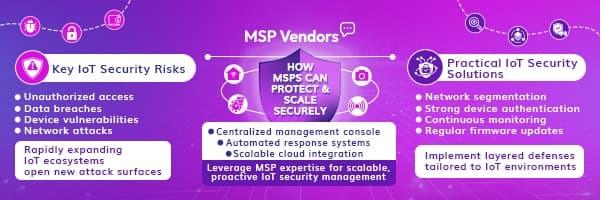
As IoT ecosystems expand, MSPs must lead the way in helping clients secure every connected device, not just the obvious endpoints. Below are six practical strategies that can help reduce risk, build trust, and deliver real value across IoT-heavy environments.
Segment Your Network
One of the simplest and most effective ways to contain threats is network segmentation. By isolating IoT devices from critical infrastructure, like servers, databases, or internal business systems, you limit the blast radius of a potential breach. Even if one device gets compromised, the damage can be contained. MSPs can create VLANs, use firewalls, and apply access control lists to enforce boundaries without interrupting operations.
Implement Zero-Trust Architecture
Zero trust flips the traditional “trust but verify” model on its head. It assumes no device or user is trustworthy by default, even inside the perimeter. For IoT, this means continuous verification of device identity, limited access rights, and context-aware authentication. Implementing zero trust doesn’t have to happen all at once, but it should start with policies that restrict what each device can see and do.
Utilize Strong Public Key Infrastructure (PKI)
Many IoT devices communicate across the internet or within a local network using unsecured protocols. Implementing PKI helps encrypt that communication and verify device identities. MSPs should work with vendors that support device certificates and manage keys properly. This prevents spoofing and ensures only trusted devices interact with sensitive systems.
Regularly Update Device Firmware
Outdated firmware is one of the most common attack vectors in IoT. Yet many devices don’t alert users when updates are available, or they require manual intervention to apply patches. MSPs should maintain a centralized inventory of IoT assets and ensure firmware updates are part of routine maintenance schedules. If a vendor no longer supports a device, that device may need to be replaced.
Monitor Devices and Establish Threat Detection
You can’t protect what you can’t see. MSPs should deploy tools that provide real-time visibility into device behavior and network traffic. Unusual activity, like a sensor reaching out to an unknown IP address, can be a sign of compromise. Modern security platforms with behavioral analytics and intrusion detection features can alert teams before small issues escalate.
Plan for Scalability
As clients add more devices, their security strategies must grow with them. MSPs should help businesses choose solutions that scale across multiple locations and device types without creating bottlenecks. That includes automated asset management, cloud-based security controls, and remote monitoring capabilities. Scalability also means future-proofing policies to handle new classes of devices as technology evolves.
Secure Every Connection: Why MSPs Must Lead the Charge in IoT Security
The conversation around IoT security is no longer optional but mission-critical. As IoT devices become embedded in nearly every client environment, MSPs are uniquely positioned to step in and lead with clarity, strategy, and confidence.
Clients may not always recognize the risks tied to their smart thermostats, warehouse sensors, or connected lighting systems. But they will notice the impact of a breach, downtime, or compliance failure. That’s where your expertise makes the difference.
Now is the time to assess your current security offering and ask: Are we ready to support an IoT-connected future? The answer doesn’t have to be complicated. Start with the basics: gain visibility over every device, implement strong identity and network controls, and make security a conversation that happens before things go live, not after.
IoT security isn’t a one-time fix, but an evolving service that sets proactive MSPs apart. Whether you’re advising small businesses or large enterprises, taking the lead on IoT protection not only reduces risk but reinforces your role as a strategic partner in their long-term growth.