
MSP SLAs Done Right: The Hidden Key to Client Retention and Trust
A clear, well-documented Service Level Agreement (SLA) is critical for any MSP. Learn how SLAs define expectations, improve service delivery, and strengthen client relationships.
Service Level Agreements (SLAs) do more than outline metrics; they define the working relationship between a Managed Service Provider (MSP) and its clients.
For MSPs navigating the complexity of recurring service delivery, the SLA becomes both a technical framework and a communication tool. It’s where expectations are clarified, responsibilities are assigned, and outcomes are measured.
But not all SLAs are created equal. A poorly structured SLA can lead to ambiguity, missed obligations, or even client churn. On the other hand, a well-maintained transparent SLA can be the backbone of client trust and operational consistency. It allows MSPs to manage risk, set realistic goals, and align internal teams with client-facing commitments.
In this article, we’ll explore what SLAs mean in the MSP context, why they’re foundational to sustainable growth, and how to build agreements that actually support service excellence instead of just ticking boxes.
What are Service Level Agreements (SLAs) for MSPs?
An SLA is a formalized contract that defines the scope, quality, and timeframe of services provided by an MSP. While the format may vary between providers, the function remains consistent: to clearly document what the client can expect and what the provider is responsible for delivering.
In the MSP space, SLAs typically outline service categories, like help desk support, uptime guarantees, response times, escalation paths, hours of coverage, and performance targets. They might also include exclusions, security obligations, and provisions for compliance reporting, especially for clients in regulated industries.
Importantly, an SLA is not just a checklist of deliverables. It’s a living document that evolves as the client’s needs change or as the MSP matures its own offerings. Whether servicing SMBs or enterprise clients, SLAs need to be specific enough to guide internal operations while remaining flexible enough to scale alongside business growth.
For most MSPs, the SLA also doubles as a strategic communication tool. It helps set expectations from day one and reduces ambiguity during incidents or escalations. It’s not about legal protection alone, but about proactive alignment.
Why are SLAs important to MSPs?
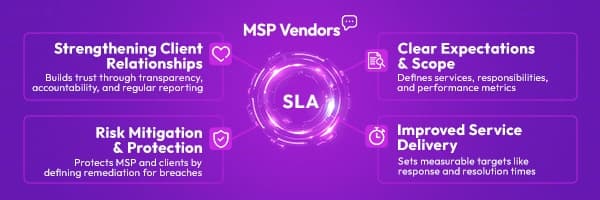
A well-crafted SLA is both helpful and foundational. If you’re an MSP that juggles multiple clients, vendors, and service tiers, the SLA is your backbone of predictable and high-quality delivery. Below, we unpack five key reasons why SLAs matter.
Establish Clear and Transparent Expectations
Misunderstandings often stem from unspoken assumptions. SLAs solve that by making service boundaries explicit. They clarify response times, resolution windows, and what services fall under the contract. This reduces the risk of disputes and gives both parties a shared reference point for what success looks like.
For example, if a client expects a 30-minute response on all tickets, but the MSP’s SLA promises a four-hour response for low-priority issues, that’s a gap that can only be addressed proactively through documentation.
Bolster the Vendor/Client Relationship
Trust grows when both sides know what to expect. SLAs offer that stability. By outlining the “how” and “when” of service delivery, MSPs can demonstrate professionalism and reliability early in the relationship. Over time, consistent adherence to SLA commitments helps reinforce credibility and increase client retention.
The most successful MSPs use SLAs not just as a contract, but as a strategic touchpoint, something they review with clients during QBRs or renewal cycles to demonstrate value.
Define the Terms of Remediation
No MSP is immune to service disruptions. What matters is how they’re handled. SLAs provide a framework for remediation by laying out escalation paths, response protocols, and recourse options. When something breaks, the SLA defines who acts, how fast, and what the client can expect in terms of updates or restitutions.
For clients, this creates peace of mind. For providers, it’s a clear guide for reducing chaos during high-pressure incidents.
Accurate Planning and Predictable Outcomes
SLAs are not just for clients; they’re equally critical for internal operations. When technical teams know the required response and resolution times, they can prioritize work accordingly. Dispatching becomes more efficient, staffing decisions are easier, and resource allocation is based on contractual obligations rather than assumptions.
Predictability allows MSPs to scale sustainably. With well-structured SLAs, teams can plan against concrete targets instead of reacting to guesswork.
Improve internal processes
SLAs also highlight gaps. If a provider consistently struggles to meet a certain metric. Let’s say, time to resolution for after-hours tickets, that data can trigger internal reviews. Maybe the help desk is understaffed. Maybe the documentation needs updating. In either case, the SLA becomes a diagnostic tool for improving process maturity.
Over time, MSPs that actively measure and revisit SLA performance tend to be more efficient, more agile, and more competitive.
How MSPs Maintain a High Level of Service: SLA Best Practices
An SLA is only as good as the systems supporting it. Once service commitments are in place, MSPs must consistently meet, or even exceed, those benchmarks. This requires more than good intentions. It requires processes, tools, and a framework that turns expectations into execution.
Below are several best practices that successful MSPs follow to keep SLA delivery strong and sustainable.
Use SMART Goals
Generic commitments like “timely response” or “fast resolution” don’t hold up in real-world environments. SLAs need to be Specific, Measurable, Achievable, Relevant, and Time-bound (SMART). For example: “Priority 1 incidents will receive a response within 15 minutes and resolution within 2 hours.” That is a measurable promise, not a vague hope.
SMART goals also make it easier to assess performance internally and with clients. There is no debate over what’s been met and what hasn’t.
Internal SLAs Should Mirror Client SLAs
If your team isn’t bound by the same timelines that you’ve promised externally, delivery gaps are inevitable. Internal SLAs, used between departments or within your service desk, should reflect client-facing terms. This keeps everyone aligned and accountable.
For instance, if the external SLA requires a response within 30 minutes, your triage team should have internal triggers that ensure alerts or escalations happen in less than that window. Otherwise, service degradation is built in by design.
Update the SLA Regularly
SLAs should evolve as service offerings, tools, and client needs change. A static SLA written during onboarding won’t reflect changes in business scope, compliance obligations, or evolving cybersecurity expectations. That’s why progressive MSPs review SLAs during renewal periods, QBRs, or when introducing new service packages.
Treat the SLA as a living document. Even minor revisions, such as adding multi-factor authentication response expectations, can prevent major misunderstandings down the line.
Use Transferrable SLAs
Standardization across client accounts helps MSPs scale. Instead of reinventing the SLA for each client, start with a templated framework and customize where needed. This approach keeps service tiers consistent, simplifies reporting, and reduces operational friction.
It also ensures your tech stack, especially monitoring, ticketing, and reporting tools, can be configured to support standardized thresholds, rather than managing a patchwork of unique metrics.
Ensure Accurate Monitoring
You can’t manage what you don’t measure. Every SLA metric, response times, uptime, and mean time to resolution must be tracked by reliable systems. Ideally, monitoring tools integrate with ticketing platforms to automate SLA compliance tracking, send alerts on breaches, and provide detailed reporting for client reviews.
Accurate monitoring also gives MSPs the data they need to spot trends and preempt failures. If response times are slipping, you’ll see it before the client calls you out.
Include Security Clauses
With cyber threats escalating, more clients expect security-related commitments inside SLAs. This could include patching timeframes, breach notification protocols, or response metrics tied to suspicious activity alerts.
While SLAs shouldn’t replace full security documentation, like an incident response plan, they should reflect baseline commitments for protecting client environments. This is especially important for clients in healthcare, finance, and other regulated sectors.
Indemnification and recourse
Even in strong partnerships, things can go wrong. SLAs should include clauses outlining indemnification, breach consequences, or potential remedies, whether that is service credits, termination clauses, or escalation terms.
While no MSP wants to invoke these clauses, including them demonstrates maturity and builds trust. Clients feel more secure knowing there’s a plan if service expectations aren’t met, and MSPs protect themselves with clearly defined limits of liability.
Rethink the SLA: It’s More Than a Contract – It’s Your Competitive Edge
For MSPs navigating rapid growth, client turnover, or evolving compliance demands, the SLS is no longer just an agreement, but a reflection of your operational maturity. It sets the tone for every client relationship, every ticket resolved, and every expectation met or missed.
If your SLAs haven’t been revisited lately, or you’re still relying on boilerplate language that doesn’t match how your team actually works, now is the time to recalibrate. The best MSPs don’t just document service, but also deliver it with precision, clarity, and accountability.
Take stock of your current SLAs. Do they support scalable service delivery? Are they tightly aligned with internal KPIs and tools? Are they security-aware and audit-ready?
If not, it’s time to rethink how you define, manage, and measure your promises.