
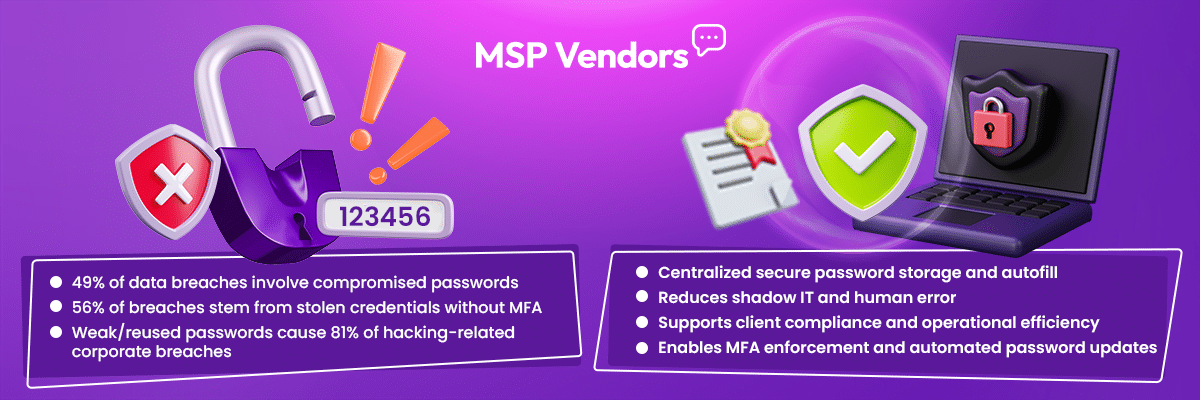
Elevating Password Management: Practical Strategies MSPs Need to Secure Clients and Expand in 2025
Poor password hygiene is still one of the leading causes of security breaches in MSP environments. Learn how password management can help secure your stack, streamline operations, and support client compliance in 2025.
In the realm of Managed Service Providers (MSPs), the significance of robust password management cannot be overstated.
Recent findings highlight a pressing concern: a staggering 94% of over 19 billion leaked passwords were reused across multiple accounts, underscoring the pervasive issue of password reuse and its implications for security breaches.
This alarming statistic isn’t just a general cybersecurity concern; it’s a direct challenge for MSPs who manage multiple client environments, internal systems, and third-party tools. The complexity of these operations amplifies the risks associated with poor password practices.
Moreover, the human element remains a critical vulnerability. Many users continue to rely on easily guessable passwords like “123456” or “admin,” which are among the most commonly compromised credentials.
In this blog post, we’ll delve into the importance of password management for MSPs, explore best practices, and provide actionable strategies to fortify your security posture in 2025.
Why MSPs Need Password Management
MSPs manage access to dozens, sometimes hundreds, of client environments, making password security a frontline concern. But despite the high stakes, many still rely on spreadsheets, shared logins, or outdated vaults. These habits create major vulnerabilities, especially as teams scale and the number of endpoints grows.
Password-related incidents are among the most common security issues for MSPs, often tied to weak internal controls or unmanaged privileged access. It’s not just a security risk; it’s a business risk. A single compromised credential can lead to downtime, SLA violations, and loss of client trust.
Compliance adds another layer. Clients in healthcare, finance, and education expect secure, auditable access controls. Offering password management isn’t just best practice but part of delivering compliant, enterprise-grade service.
Understanding The Importance of Password Management for MSPs
Before diving into specific solutions, it’s important to understand why password management deserves a dedicated strategy within every MSP. While it might seem basic compared to advanced threat detection tools or SIEM platforms, poor password hygiene remains one of the top causes of security incidents.
In the context of MSP operations, where access is broad and responsibility spans multiple environments, the consequences of weak or mismanaged credentials can be wide-reaching and difficult to contain.
The Role of Passwords in MSP Security
Passwords remain a primary defense mechanism in MSP environments, safeguarding access to client systems, internal tools, and cloud services. Despite advancements in authentication methods, passwords are still widely used and, unfortunately, often mismanaged. The complexity of MSP operations, managing multiple clients, diverse systems, and numerous technicians, amplifies the risk associated with poor password practices.
A significant concern is the prevalence of password reuse. In 2024, over 1.7 billion credentials were harvested through active infections on users’ devices, with many of these credentials being reused across multiple platforms. This widespread reuse makes it easier for attackers to compromise multiple accounts once a single password is obtained.
Risks of Poor Password Management
The dangers of inadequate password management are not hypothetical. In July 2024, nearly 10 billion unique plaintext passwords were leaked in what has been dubbed the largest password compilation to date, known as “RockYou2024.” Such massive leaks provide attackers with extensive resources to conduct credential stuffing attacks, where stolen passwords are used to gain unauthorized access to various accounts.
For MSPs, the implications are severe. A single compromised credential can lead to unauthorized access to multiple client environments, resulting in data breaches, financial losses, and reputational damage. Moreover, regulatory compliance requirements, such as those outlined in HIPAA, PCI DSS, and other frameworks, mandate stringent access controls and password management practices. Failure to adhere to these standards can result in legal penalties and loss of client trust.
Implementing robust password management strategies is not just a security measure but a business imperative for MSPs aiming to protect their operations and client data.
Password Management Best Practices for MSPs
As MSPs scale, password complexity and security challenges grow in parallel. Without consistent guardrails, technicians may default to insecure habits: reusing passwords, storing them in local files, or bypassing policy enforcement under time pressure. These best practices form the backbone of a secure, scalable approach to password management across your internal team and client environments.
Implement Multi-Factor Authentication (MFA)
Even the strongest password can be compromised. MFA reduces risk by requiring an additional verification layer, typically a mobile app, token, or biometric factor. MFA should be enforced across all critical systems, including your PSA, RMM, cloud accounts, and password vault. For MSPs, this also means ensuring MFA is configured correctly for client admin accounts, not just internal logins.
Use a Secure Password Generator
Encourage technicians to use complex, unique passwords for each system, ideally 16+ characters and randomly generated. Manual creation usually leads to predictable patterns. Most enterprise-grade password managers offer built-in generators that can create strong, unique credentials for every login. Over time, this eliminates dangerous reuse and makes brute-force attacks far less viable.
Centralize Credential Storage and Access
Scattered spreadsheets and personal vaults don’t scale. Adopt a centralized password management tool that supports team-based access controls, role-specific permissions, and audit logs. This ensures visibility into who accessed which credentials and when. It also simplifies onboarding, offboarding, and managing shared access to client environments.
Rotate Passwords Regularly
Even well-protected passwords can be exposed. Set policies to rotate high-privilege credentials (e.g., domain admin accounts, firewall logins) on a scheduled basis or after key personnel changes. Some tools offer automated password rotation and API integrations for seamless updates across systems. This minimizes exposure windows if a password is compromised.
Educate Clients on Secure Password Habits
MSPs often serve as de facto security advisors. Train client admins on best practices, such as avoiding password reuse, enabling MFA, and not emailing credentials. If you offer a client-facing portal or access to shared tools, provide guided onboarding on secure authentication policies. Education reduces support tickets and strengthens your value as a security partner.
Know What Not to Use
Avoid default, guessable, or recycled passwords. Public breaches continue to show that combinations like “123456,” “admin,” and company names followed by “2024” are among the most frequently exploited. Reference public datasets like Have I Been Pwned or use your password manager’s breach-checking features to screen known-compromised credentials.
These practices don’t just reduce risk; they streamline technician workflows, support regulatory compliance, and help build a security-first culture across your stack.
Overcoming Common Password Management Challenges
Even with strong policies and tools in place, many MSPs encounter the same roadblocks when trying to enforce consistent password hygiene. Addressing these issues head-on is key to building a sustainable security framework that actually works in day-to-day operations.
Dealing With Password Fatigue
Technicians often manage dozens of logins across various clients and tools. Without automation, remembering or constantly retrieving unique passwords becomes frustrating, and leads to shortcuts like reusing credentials or keeping them in plaintext notes. The solution isn’t to burden your team with memorization but to reduce cognitive load through a trusted password manager that supports autofill, tagging, and access by role. Done right, it can make secure behavior the easier option, not the harder one.
Managing Multiple Passwords Across Clients
Different clients may have their own password policies, levels of access, or legacy systems that don’t support modern authentication. MSPs need a strategy that balances consistency with flexibility. Look for tools that allow credential grouping by client, service, or technician role, while still keeping auditability intact. Avoid the trap of using one-size-fits-all passwords for “convenience.” It only takes one breach to compromise the rest.
Ensuring Compliance with Password Policies
Whether you serve healthcare clients under HIPAA or financial firms under PCI DSS, password policies must align with your clients’ compliance obligations. That means enforcing password complexity, expiration, and MFA, but also ensuring these settings are logged and reviewable. The right password management system should allow policy customization, generate compliance reports, and support integration with your documentation and audit workflows.
These challenges aren’t signs of failure; they’re signals that it’s time to evolve how password security is handled. A combination of smart tooling, technician support, and client education can turn password management from a security liability into a long-term advantage.
Take Control of Password Security Before It’s Too Late
Effective password management is no longer optional, but a critical pillar of MSP security and client trust. By adopting proven best practices and investing in the right tools, MSPs can dramatically reduce their attack surface, improve operational efficiency, and demonstrate compliance with industry standards.
If you haven’t already, now is the time to evaluate your current password management strategy. Consider integrating centralized password vaults, enforcing multi-factor authentication, and training your team and clients on secure habits. These steps will position your MSP as a proactive security partner in an increasingly complex threat landscape.
Strengthen your defenses today, because in cybersecurity, prevention is the best service you can offer.