
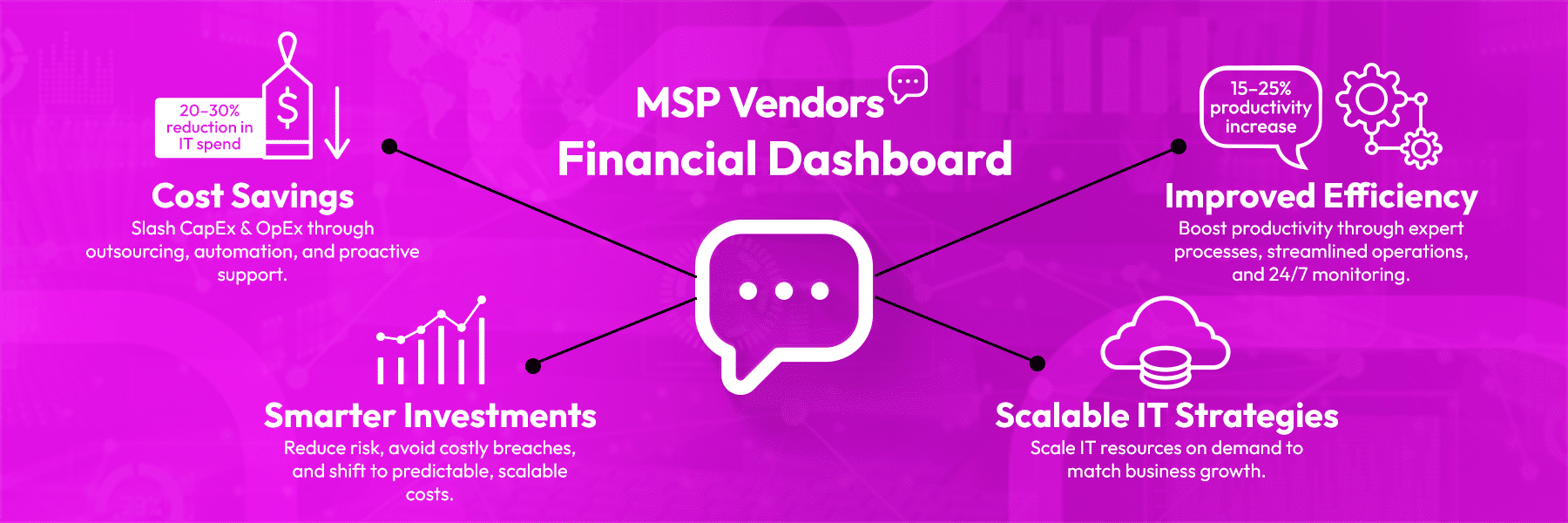
MSPs and the Bottom Line: What Every Business Needs to Know About the Economic Impact of Managed Services
Explore how Managed Service Providers (MSPs) drive real economic value through cost savings, improved efficiency, smarter investments, and scalable IT strategies. Backed by recent data, this article breaks down the financial impact MSPs deliver in today’s market.
Outsourcing IT used to be a cost-cutting move. Today, it’s a business strategy.
In 2025, Managed Service Providers (MSPs) aren’t just keeping the lights on, they’re driving digital transformation, maximizing value from infrastructure, and helping businesses pivot faster in volatile markets. And the impact is measurable.
According to Market.us, the global managed services market is projected to hit $410.2 billion by 2032, growing at a CAGR of 11.3%. That’s more than a trend; it’s a realignment of how businesses think about IT investments.
Behind that growth is a practical reality: most small and mid-sized businesses (SMBs) simply can’t keep up with the cost and complexity of modern IT.
Canalys reports that 60% of channel partners expect revenue growth in 2025, specifically from managed services, as demand shifts toward predictable service models and outsourced expertise.
For decision-makers on the fence about MSP partnerships, the numbers paint a clear picture. Managed services are no longer optional but economically essential. Let’s unpack what’s fueling this shift and how MSPs are changing the financial calculus for organizations in every sector.
Overview of Managed Service Provider Market
The MSP landscape has shifted from niche support to strategic infrastructure. What was once considered a “nice-to-have” safety net for break-fix IT is now at the center of how companies plan, budget, and scale their operations.
MSPs now serve as primary IT partners for over 60% of SMBs in the U.S., handling everything from endpoint management to identity and access control. Their role has deepened in response to a more hybrid, decentralized workforce and rising cybersecurity threats that traditional internal IT teams are often unequipped to handle alone.
It’s not just SMBs driving demand. Larger organizations are also shifting portions of their tech stack to MSPs to avoid the high cost of maintaining always-on, specialized teams. The market is further buoyed by increased compliance pressure, especially in healthcare, finance, and manufacturing, where audits and regulations demand consistent IT governance.
This demand is translating into real growth. MSPs now manage over 100 million endpoints globally. With most providers bundling solutions like identity, device, and patch management into monthly subscription packages, the model appeals to clients looking for both predictability and flexibility.
The result? A fragmented, but fast-maturing market, where specialization matters as much as scalability. MSPs who can pair core services with strategic consulting are emerging as long-term partners, not just vendors. In many cases, the MSP is the IT department.
The Economic Impact of MSPs
The managed services model isn’t just a response to IT complexity; it’s a financial strategy. Businesses are choosing MSPs not only to reduce overhead but to unlock new areas of operational efficiency and revenue growth. From measurable cost savings to stronger ROI compared to in-house teams, the numbers show that MSPs are delivering economic value that scales.
Cost Savings and Efficiency Improvements
Cost control remains a major driver for MSP adoption. According to Grand View Research, the global managed services market is projected to reach $731.08 billion by 2030, growing at a CAGR of 14.1% from 2025 to 2030. This rapid expansion reflects how businesses are leveraging MSPs to replace high-cost internal IT with efficient, outcome-driven services.
MSPs help clients reduce operational IT costs by up to 40% through centralized endpoint management, vendor consolidation, and proactive monitoring. These cost savings extend beyond basic IT functions; MSPs are also minimizing downtime, automating repetitive tasks, and optimizing license usage, all of which improve productivity and reduce total cost of ownership.
For SMBs, avoiding even a few hours of downtime per month can preserve thousands in revenue, especially for the ecommerce, healthcare, and finance sectors, where operational continuity is critical.
Revenue Generation Areas for MSPs
MSPs aren’t just reducing costs; they’re unlocking new revenue streams by offering specialized services tailored to client needs. As stated in the same Canalys report, 74% of MSPs expect to expand their service portfolios in 2025, particularly in high-value areas such as cybersecurity, compliance consulting, and cloud enablement.
MSPs offering device and identity management services are experiencing 1.5x faster growth than generalist firms. These offerings meet urgent market demand for secure remote work infrastructure, zero trust security models, and hybrid IT environments, while enabling MSPs to differentiate through vertical expertise and strategic value.
Additionally, consulting around compliance frameworks (like HIPAA, PCI DSS, and SOC 2) is becoming a steady source of recurring revenue, especially in regulated industries where in-house IT may not have the capacity or expertise to keep up.
Comparison of In-House IT vs. Managed Services
Internal IT teams remain valuable, but the economics of staffing them in-house are increasingly difficult to justify, particularly for small to mid-sized businesses. The U.S. Bureau of Labor Statistics reports that the median annual wage for computer and information systems managers was $171,200 in May 2024. And that figure doesn’t include recruitment, benefits, training, or retention costs in a highly competitive labor market.
MSPs, by contrast, operate on a shared-services model that spreads high-level talent across multiple clients. This enables even small firms to access cybersecurity expertise, 24/7 monitoring, and compliance readiness without carrying full-time overhead. The model also scales more flexibly with demand, allowing organizations to add or remove services based on budget, project load, or new business requirements.
When businesses compare service level agreements (SLAs), uptime, and cost-to-benefit ratios, many find MSPs outperform in-house teams in both performance and value. This is especially true in scenarios requiring high availability, rapid response, or ongoing compliance maintenance.
The Economic Advantages of Managed Services
While many MSP engagements begin as a cost-control measure, the long-term economic benefits go far beyond initial savings. Managed services unlock efficiency at multiple levels of an organization, from staffing and infrastructure to strategic reinvestment and business agility. As IT environments grow more complex, MSPs are not just service providers; they’re economic enablers.
Staff Utilization
MSPs play a pivotal role in enhancing the productivity of internal IT teams by assuming responsibility for routine tasks such as troubleshooting, patching, and system monitoring. This delegation allows in-house staff to concentrate on strategic initiatives that drive business growth.
A report by Service Leadership, Inc. indicates that top-performing MSPs achieve staff utilization rates of 73.2%, compared to 54.9% among median performers and 48.3% among bottom-tier companies. This higher utilization correlates with increased productivity and more efficient service delivery.
Furthermore, the 2025 MSP Business Trends Report by ScalePad highlights that leading MSPs optimize internal operations, including employee engagement and resource allocation, to enhance staff productivity and overall business performance.
Additionally, the same JumpCloud MSP Trends Report notes that MSPs contribute to improved productivity by streamlining IT operations, enabling businesses to reallocate resources towards innovation and growth.
By outsourcing routine IT tasks to MSPs, organizations can achieve higher staff productivity, reduce burnout, and foster a more strategic use of internal resources.
Getting the Most Out of Assets
Maximizing the use of existing IT assets is a significant economic benefit MSPs provide. Many organizations face challenges with underutilized hardware and software licenses due to limited time or expertise for ongoing management.
MSPs employ proactive management and analytics to help clients fully leverage their technology investments. According to the Flexera 2023 State of IT Asset Management (ITAM) Report, enterprises continue to waste IT spending, with respondents reporting underutilization or wasted IT spending of 36% for desktop software, 33% for data center software, 32% for SaaS, and 32% for IaaS/PaaS. Implementing robust ITAM practices can significantly reduce these inefficiencies.
Additionally, the ITAM Insights Report 2023 by The ITAM Review emphasizes the importance of IT asset management in optimizing operational efficiency, enhancing cybersecurity measures, and maintaining compliance with regulatory requirements. The report highlights that effective ITAM is essential for organizations seeking to ensure competitiveness and success in the evolving digital landscape.
By improving asset utilization, MSPs help businesses lower costs and increase the value derived from their IT infrastructure, directly benefiting the bottom line.
Investment Opportunities
MSPs enable businesses to reallocate resources from routine IT operations to strategic initiatives, effectively transforming fixed costs into variable expenses. This shift allows organizations to invest more in innovation and growth.
According to Deloitte’s 2023 Global Technology Leadership Study, the average technology budget as a percentage of revenue increased to 5.49%, up from 4.25% in 2020. This rise reflects a growing emphasis on technology investments to drive business value.
Furthermore, Deloitte’s insights highlight that organizations are increasingly turning to next-generation managed services to address complex challenges and enhance agility. These services go beyond traditional outsourcing by focusing on innovation-driven engagements that allow businesses to operate with greater flexibility and responsiveness.
By leveraging MSPs, companies can optimize their IT spending, reduce operational risks, and accelerate time-to-market for new products and services, thereby unlocking long-term value and gaining a competitive edge.
Transition
MSPs play a crucial role in facilitating seamless business transitions, whether it’s scaling operations during growth phases, downsizing, or navigating mergers and acquisitions. Their expertise ensures that organizations can adapt to changes without significant disruptions.
According to Forbes, MSPs are increasingly adopting automation and AI-driven tools to streamline service delivery, enabling businesses to scale efficiently and respond swiftly to market demands. This technological integration allows for rapid deployment of services and minimizes downtime during transitions.
Furthermore, TechTarget highlights that MSPs are evolving their offerings to include advanced cloud provisioning and hybrid IT solutions. These services provide businesses with the flexibility to scale their IT resources up or down based on current needs, ensuring optimal resource utilization and cost-effectiveness.
By leveraging the capabilities of MSPs, organizations can navigate business transitions more smoothly, maintain operational continuity, and position themselves for sustained growth.
Turn IT Costs into Strategic Growth with the Right MSP
From driving cost efficiency to maximizing asset value and enabling smarter investment, Managed Service Providers have become vital economic partners for today’s businesses. As this blog outlined, from the rising market demand to specific financial advantages, MSPs aren’t just technical support vendors. They’re business enablers.
If your organization is navigating growth, transitions, or simply trying to do more with less, the right MSP can help you convert operational spending into measurable business outcomes.
Start identifying MSP partners who align with your long-term goals, not just your short-term fixes.