
How MSPs Strengthen Cyber Resilience in an Unpredictable Threat Landscape
Explore the critical role Managed Service Providers (MSPs) play in strengthening cyber resilience. Learn how MSPs help businesses protect data, recover from attacks, and adapt to evolving cyber threats.
Cyberattacks are a constant, evolving reality. For small and mid-sized businesses (SMBs), the stakes are high.
According to the IBM Cost of a Data Breach Report 2024, the global average cost of a data breach reached $4.88 million, a record 10 percent increase year-over-year, the largest spike since the pandemic. But beyond the headline figures, attackers are disrupting real-world operations: 70 percent of breached organizations reported significant or very significant business disruption.
That’s where MSPs come in, and where cyber resilience takes center stage.
Organizations are increasingly turning to their MSP partners not just for protection, but for adaptability and endurance. A resilient organization doesn’t just block threats; it recovers quickly, learns from incidents, and evolves its defenses. This shift in strategy, from pure prevention to resilience, opens the door for MSPs to deliver deeper value, especially as threat actors deploy more sophisticated tactics.
In this blog, we’ll unpack what cyber resilience actually means, explore the foundational pillars that support it, and outline 12 practical ways MSPs are helping their clients build resilience in a threat landscape that’s only becoming more aggressive.
What Is Cyber Resilience?
Cyber resilience is an organization’s ability to prepare for, respond to, and recover from cyber incidents, while keeping essential operations running. Unlike traditional cybersecurity, which focuses on prevention, resilience assumes that breaches can still happen and focuses on minimizing impact and recovery time.
It’s more than just defense. Resilient businesses have systems and strategies that allow them to adapt, respond, and move forward when attacks occur.
For MSPs, this shift is significant. Clients want more than tools; they want long-term assurance that their operations won’t collapse when threats slip through. The World Economic Forum points out that a strategic approach to cybersecurity is essential for achieving cyber resilience, moving security out of the basement and into board-level conversations.
Key Pillars of Cyber Resilience
Cyber resilience isn’t a single solution; it’s a framework built on several interconnected components. For MSPs looking to guide clients toward long-term security and stability, understanding these pillars is essential.
Data Protection and Backup
Data is often the first target in a cyberattack. Regular, encrypted backups ensure that critical information can be restored quickly. But resilience requires more than storage; it demands tested backup strategies, recovery time objectives (RTOs), and verification processes. MSPs that prioritize secure, automated backups build client trust by reducing the risk of irreversible data loss.
Business Continuity and Disaster Recovery
When operations go down, every minute counts. Business continuity planning (BCP) and disaster recovery (DR) are about ensuring uptime and service delivery, even during a major incident. MSPs help clients map dependencies, identify risks, and implement DR plans that align with business priorities, not just IT concerns.
Incident Response Planning
Cyber resilience means being ready before an incident occurs. A well-defined incident response (IR) plan outlines who does what, when, and how. MSPs support clients by developing playbooks, conducting tabletop exercises, and helping teams respond with speed and clarity when every second matters.
Employee Awareness and Training
Human error remains a leading cause of breaches. Resilient organizations invest in regular employee training on phishing, password hygiene, and suspicious activity reporting. MSPs that offer structured, ongoing training help clients reduce internal risks and build a stronger security culture over time.
Why Cyber Resilience is Critical in Today’s Threat Landscape
The threat landscape isn’t just evolving but accelerating. Cybercriminals are faster, smarter, and more relentless than ever. Check Point Research reported a 30% increase in weekly cyberattacks during the second quarter of 2024 compared to Q2 2023, averaging around 1,636 attacks per organization each week.
Traditional perimeter defenses no longer suffice. Threat actors often bypass controls through social engineering, unpatched systems, or vulnerabilities in the supply chain. Unlike large enterprises, many SMBs rely entirely on their MSPs for defense and recovery.
Without a cyber resilience framework, a breach can shutter operations, erode customer confidence, and trigger regulatory fines. For most businesses, it’s not a matter of if but when, and survival depends on how fast they bounce back.
That’s where MSPs make a difference. By guiding clients toward resilience, MSPs ensure continuity, not just prevention. It’s a shift from reactive fixes to proactive, long-term partnerships built to withstand whatever comes next.
12 Ways That MSPs Can Help Their Customers Improve Cyber Resilience
Cyber resilience isn’t achieved overnight. It requires consistency, collaboration, and a layered approach. MSPs are uniquely positioned to help businesses build and maintain this resilience over time. Here are 12 ways they’re doing exactly that.
Provide Comprehensive Security Awareness Training
Phishing, social engineering, and credential theft are still among the most common breach vectors, and they almost always involve human error. MSPs can significantly reduce this risk by rolling out structured, ongoing training programs that go beyond check-the-box compliance. By simulating phishing attacks, offering interactive learning paths, and tailoring content to different roles within the organization, MSPs help build cyber vigilance across all levels of the business.
Develop Incident Response Plans
A well-defined incident response plan can mean the difference between a quick recovery and prolonged disruption. MSPs guide clients through creating these plans, defining roles, escalation paths, internal and external communication procedures, and recovery actions. They also facilitate tabletop exercises to simulate real-world scenarios, allowing clients to test and refine their response strategies before an actual breach occurs.
Conduct Vulnerability Assessments
Attackers exploit unpatched systems and misconfigured assets every day. MSPs help clients stay ahead by running routine vulnerability scans, configuration reviews, and (when appropriate) penetration tests. Just as important as identifying risks is helping prioritize and address them. MSPs translate technical findings into actionable steps that align with the client’s risk tolerance and compliance needs.
Implement Multi-Factor Authentication (MFA)
MFA dramatically reduces the risk of compromised credentials, but only when it’s consistently deployed. MSPs help clients roll out MFA across cloud platforms, VPNs, remote desktops, and business-critical SaaS tools. They also assist in selecting the right method (SMS, app-based, biometric) based on the client’s environment and budget, ensuring usability doesn’t get in the way of security.
Leverage AI-Powered Threat Detection
Traditional signature-based defenses can’t keep up with today’s advanced threats. MSPs enhance detection by integrating AI-driven tools that use behavioral analysis and anomaly detection to catch threats early. Whether built into an XDR platform or integrated through SIEM solutions, these tools give MSPs faster visibility and help reduce dwell time before an attacker can do real damage.
Deploy Endpoint Detection and Response (EDR) Solutions
EDR gives MSPs the ability to continuously monitor client endpoints, detect suspicious behavior, and respond swiftly. MSPs configure and manage EDR platforms to ensure coverage across all devices, including remote and mobile users. Features like isolation, rollback, and real-time alerting allow MSPs to contain threats quickly, often before they spread to critical systems.
Offer Backup and Disaster Recovery Solutions
Cyber resilience depends on the ability to restore data and services with minimal downtime. MSPs implement automated, encrypted backups with off-site replication and regular restore testing. But it’s not just about having backups but also ensuring clients have clear recovery time objectives (RTOs) and recovery point objectives (RPOs) based on what the business can afford to lose or be without.
Bolster Regulatory Compliance
Cyber resilience and compliance are closely linked. Whether a client operates in healthcare, finance, education, or manufacturing, MSPs help map their cybersecurity posture to relevant standards like HIPAA, NIST, GDPR, or ISO 27001. This includes supporting policy development, managing access controls, and helping clients prepare for audits or regulatory reviews.
Create a Cybersecurity Playbook
A cybersecurity playbook is a tactical guide for responding to specific threats, ransomware, insider breaches, denial-of-service attacks, and more. MSPs develop customized playbooks with predefined actions, escalation paths, and communication steps based on the client’s infrastructure and threat profile. This ensures that when something happens, teams can act with speed and confidence.
Perform Regular Cybersecurity Audits
Cybersecurity isn’t static. MSPs help clients stay ahead of threats by performing periodic audits that review network configurations, access policies, endpoint protections, and user behavior. These audits surface vulnerabilities and gaps, provide measurable insights, and support continuous improvement. They’re also a key tool for communicating progress to executive stakeholders.
Encourage Continuous Cybersecurity Education
Threats evolve rapidly, and what worked a year ago might not be enough today. MSPs support continuous education through monthly threat briefings, security newsletters, executive briefings, and on-demand learning resources. Keeping both leadership and frontline employees informed helps foster better decision-making and ensures cybersecurity stays top of mind.
Foster a Security-First Culture
Ultimately, tools and plans are only effective if supported by culture. MSPs play a key role in shaping that culture by working closely with client leadership to promote accountability, transparency, and investment in security. From onboarding practices to executive communication, they help integrate security into daily operations, not as a one-off project, but as a shared responsibility.
The Time to Lead in Cyber Resilience Is Now
Clients aren’t just looking for protection but also for confidence. Cyber resilience delivers both. And MSPs are in the best position to guide that shift.
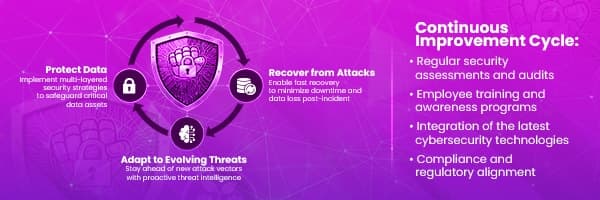
By helping businesses prepare, adapt, and recover, you’re not only minimizing risk but you’re also strengthening relationships, driving long-term value, and positioning your services as essential in a security-conscious world.
Resilience isn’t a feature. It’s a mindset. The MSPs who embrace it will be the ones clients trust to keep them running, no matter what.