White label services let MSPs scale fast without reinventing the wheel. Explore how they work, what to watch out for, and how to choose the right partner to grow your service offerings efficiently.
Let’s be honest: building every solution in-house just isn’t realistic anymore. Clients want more services, faster delivery, and specialized expertise, and they don’t care if it’s coming from your internal team or a trusted partner behind the scenes.
That’s where white label services come into play. They give managed service providers (MSPs) a way to expand their offerings without taking on the cost or complexity of developing everything from scratch. Whether it’s NOC, SOC, helpdesk, or compliance reporting, more providers are tapping into third-party expertise and rebranding it as their own.
And it’s not just small shops doing this. The white label services market is growing fast, with a projected CAGR of 14.6% through 2032 as more MSPs embrace outsourced delivery to stay competitive and profitable.
If you’ve ever felt stretched too thin or passed on a new service opportunity because your team couldn’t support it, white labeling might be the move you didn’t know you needed. But like any good growth strategy, it works best when done with care.
In this blog, we’ll walk you through what label services really are, what they offer, where the risks lie, and how you can start using them to grow without breaking your business model.
Understanding White Label Services
Definition of White Label Services
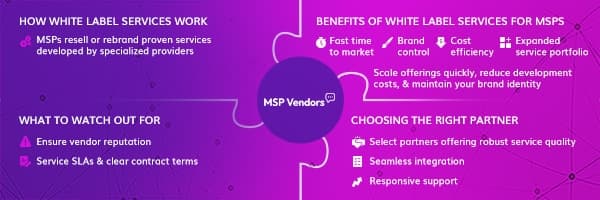
White label services are third-party solutions delivered by an external provider but branded and sold by an MSP as part of their own service offering. The key is that the client never sees the vendor behind the scenes. Instead, the service, whether it’s cybersecurity, helpdesk support, or cloud backup, is presented under your name, using your branding, and integrated into your overall client experience. This gives MSPs the ability to offer more without building everything from scratch, making it a strategic option for scaling efficiently.
Core Components of White Label Services
A complete white label setup typically includes three foundational elements: back-end service delivery handled by the vendor, rebrandable assets like reports and portals, and integration capabilities that connect with your existing tools, such as PSA or RMM platforms.
Many providers also offer SLA alignment, compliance support, and client-facing resources that can be customized with your logo and voice. These components ensure a seamless experience for your clients while allowing your internal team to stay focused on strategy, customer relationships, and higher-value work. White labeling is not just about filling gaps but also extending your capabilities without compromising your standards.
The Importance of White Label Services for MSPs
White label services give MSPs a way to grow smarter. They help you meet client demands, expand your offerings, and drive revenue without overloading your internal team.
Enhancing Service Offerings
For many MSPs, a client demands move faster than internal resources can keep up. White label services help bridge that gap by allowing you to offer new capabilities, like 24/7 support, advanced threat detection, or compliance tools, without waiting months to hire or train in-house talent. Instead of turning away opportunities or overextending your team, you can respond confidently with a broader, more competitive portfolio. This flexibility helps MSPs stay relevant, meet evolving client needs, and differentiate themselves in crowded markets.
Increasing Revenue Streams
Adding white label services can unlock new revenue without the heavy overhead that usually comes with scaling. Since these services are delivered by external partners, your operational costs stay lean, and profit margins can stay healthy. Whether it’s bundling security tools into premium packages or offering specialized compliance monitoring, white labeling gives you the ability to upsell and cross-sell in ways that boost monthly recurring revenue. For growth-minded MSPs, it’s a strategic way to increase value without increasing risk.
Benefits of Adopting White Label Services
White label services are not only a shortcut but a strategic tool that can help MSPs scale, streamline, and stay competitive. When implemented well, they offer clear advantages that go beyond simply filling service gaps.
Expansive Service Portfolio
With white label partnerships, MSPs can quickly add new services without having to build them in-house. This means that you can meet client demands across areas like cybersecurity, cloud management, or compliance, even if those are not your core specialties. It gives you the flexibility to serve more industries, close more deals, and stay competitive as client expectations evolve.
Efficiency and Cost-Effectiveness
Outsourcing delivery through a white label model reduces the time, cost, and staffing needed to support new offerings. You avoid the long ramp-up period of hiring or training and gain instant access to expert-level service delivery. For many MSPs, this leads to stronger margins, better scalability, and less operational stress.
Customizability and Branding
A good white label partner lets you make their solution feel like your own. From client reports and dashboards to portals and communications, everything can be customized to reflect your brand. This helps maintain consistency across the client experience and reinforces trust, even when service execution is happening behind the scenes.
Potential Drawbacks to Consider in Adopting White Label Services
As with any growth strategy, white labeling isn’t without its challenges. It’s important to understand the trade-offs before diving in, especially when it comes to control, differentiation, and operational fit.
Loss of Control
When a third party is responsible for delivering part of your service, there’s always a risk that something might slip through the cracks. You are still accountable to your clients, even if you’re not the one handling the task directly. That means any misstep, like missed SLA, communication gap, or quality issue, can reflect poorly on your brand. Without clear oversight, maintaining consistency across the client experience can become a challenge.
Competitive Advantage
If you rely too heavily on white label services that other MSPs also use, it may become harder to stand out. When multiple providers are reselling the same solutions, differentiation comes down to how well you manage the relationship, bundle services, and deliver client value. Without that layer of strategic positioning, your offerings could start to feel like just another version of what every other MSP is selling.
Integration Complexity
White label solutions often need to plug into your existing systems, whether it’s your PSA, RMM, or client portal. Depending on the vendor, this integration can be smooth or frustratingly complex. Poor compatibility can slow down operations, create ticketing or reporting inconsistencies, and introduce extra layers of troubleshooting that weren’t there before. It’s important to assess how well the services fit into your current workflow before making the leap.
Implementing White Label Services in Your MSP Business
Once you’ve decided to explore white label services, the next step is making sure the rollout is smooth and aligned with your goals. A thoughtful implementation process helps avoid common pitfalls and sets the foundation for a strong, long-term partnership.
Evaluate Your Needs
Before jumping into a partnership, take a close look at where your MSP is stretched thin or where clients are asking for services you don’t currently offer. Identify gaps in delivery, expertise, or coverage hours. This clarity helps ensure you’re not just adding services for the sake of it but choosing ones that align with your client base and growth strategy.
Research Potential Partners
Not all white label vendors are created equal. Look for partners with a solid track record, proven uptime, transparent SLAs, and flexible integration options. Ask how they handle escalations, what branding options they offer, and whether they’ll stay invisible in the client’s relationship. A good partner should feel like an extension of your team, not just a backend vendor.
Establish a Partnership
Once you’ve chosen a provider, take time to align expectations clearly. Set communication protocols, define service boundaries, and make sure reporting, billing, and support flows are well understood on both sides. The smoother this handoff, the better the client experience will be.
Integrate Seamlessly
Work with the vendor to connect their tools to your PSA, RMM, or client portal. Customize branded assets so they reflect your look and feel. Test how the process works from end to end, ticket creation, response times, escalations, before rolling it out to clients. The goal is to make the transition invisible on the client side.
Monitor and Optimize
Even after the service is live, stay involved. Monitor performance, review reports, and gather client feedback. White label partnerships aren’t set-and-forget but also require active management to keep quality high and ensure the service continues to meet your standards. Regular check-ins with your vendor can surface issues early and keep the relationship strong.
Choose The Right White Label Partner Today
White label services can unlock real growth for MSPs, but only if you choose a partner who aligns with your standards, your systems, and your clients' expectations. The right provider won’t just fill gaps; they’ll help you deliver more value, faster, and with less overhead.
If you're considering expanding your offerings or scaling without overextending your team, now’s the time to explore white label partnerships that make sense for your business.
Start with a clear understanding of what you need, vet your options carefully, and treat your vendor as a strategic part of your delivery model.
Your clients may never know there’s another team behind the scenes, but they will notice the results.